
Commitment to responsible animal research
Advancing life-saving medicine with care, oversight and integrity
A message from Provost Terence R. FlotteKey fact
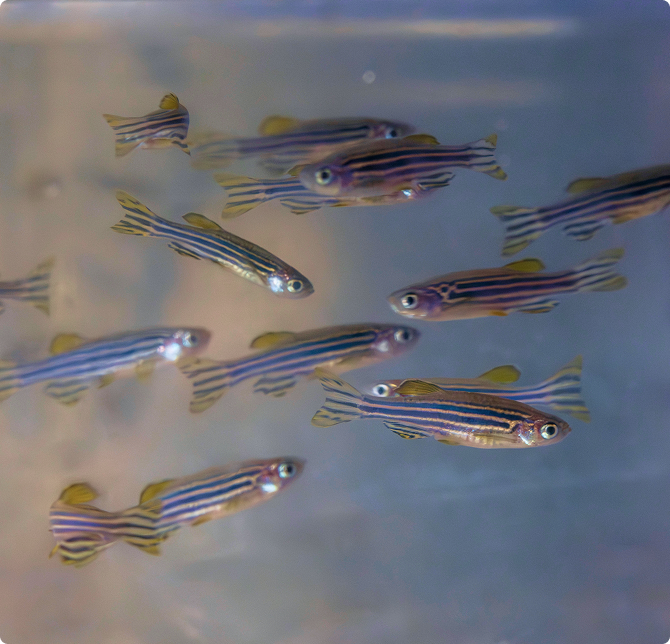
Nearly 95 percent of the animals used in research at UMass Chan are mice, rats and zebrafish.
Why this research matters
Research at UMass Chan Medical School has helped advance treatments for some of the most intractable diseases of our time, including HIV, cancer, diabetes, ALS and infectious diseases such as COVID-19.
UMass Chan has led numerous first-in-human clinical trials of novel genetic therapies, including for ALS, Tay-Sachs and Cockayne syndrome.
Every FDA-approved drug requires preclinical research before it can be used on a single patient.
Lives changed by research
How an investigational gene therapy developed at UMass Chan Medical School is making the difference for one family

She’s getting to live a mostly normal childhood and all of that is because of the scientific advances developed in the UMass Chan labs.
– Lee and Lori Greenwood
Myths vs. facts
Myth
With modern technology, there is no reason to use animals in research.
Fact
Scientists at UMass Chan and around the world are developing alternatives to laboratory animals in research, but animal models remain the gold standard and the final step often required by the federal government to test therapies for safety and efficacy prior to clinical trials in humans.
Myth
Laboratory animals are mistreated.
Fact
At UMass Chan, we believe that providing compassionate, humane care for laboratory animals is essential—not only because it is the right thing to do, but also because it is fundamental to good science and imperative to meet the demands of high-quality research.
Myth
Large animals are the most commonly used animals in biomedical research.
Fact
Nearly 95 percent of the animals used in research at UMass Chan are mice, rats and zebrafish.
Oversight at every level
Oversight is not a single step—it is a continuous system designed to ensure that research is responsibly conducted and aligned with the highest standards from start to finish.
- Federal oversight (USDA, NIH)
- Independent accreditation (AAALAC)
- IACUC review and approval
- Veterinary care and monitoring
- Commitment to the 3Rs (Reduce, Refine, Replace)
Inside our research environment
Our facilities are designed to support both scientific excellence and the highest standards of care.